Category: Uncategorized

  • “This is Not a Book: Long Forms of Attention in the Digital Age”, a talk by Alan Liu. Tuesday, June 3rd at UCR!

    {DATE CHANGE}

    On June 3rd we will co-host a talk by Alan Liu; please join us!

    “This is Not a Book: Long Forms of Attention in the Digital Age”
    Alan Liu (UC Santa Barbara)

    Tuesday June 3, 11:00-12:30,

    Location: UCR INTS 1113

    Co-sponsored by Critical Digital Humanities

    This talk is free and open to the public.

    A common response to an electronic book or other digital media is that, while it may be better or worse than a book, “this is not a book.”  But digital media has the uncanny effect of making us realize that physical books themselves were never truly books–if by “book” we mean a long form of attention designed for the permanent, standard, and authoritative communication of human thought or experience.  This talk  will outline methods for discovering and tracking socially repeatable and valued “long forms of attention” whether in books or other constellations of materials, in the past or the digital present. 

    The talk  will conclude with a look at the RoSE (Research-oriented Social Environment) created by a team at the University of California, Santa Barbara, directed by Liu.

  • Book Traces

    From Andrew Stauffer and Nines.org comes a new project to find unique copies of 19th and early 20th century books on library shelves that are at risk from digitization initiatives. Many of these books are not marked as ‘rare’ or ‘unique’ and are in danger of being discarded as copies. As the site’s home page says:

    Thousands of old library books bear fascinating traces of the past. Readers wrote in their books, and left notes, pictures, letters, flowers, locks of hair, and other things between their pages. We need your help identifying them because many are in danger of being discarded as libraries go digital. Books printed between 1820 and 1923 are at particular risk. Help us prove the value of maintaining rich print collections in our libraries.

    The site also looks to be a fascinating archive of marginalia and the ephemera of literary culture in the making. Check out the examples already up at booktraces.org and submit your own examples. All they need are a few pictures and a basic description. Be a book history superhero, armed with no more than a smartphone!

  • Free Book History Talk at the Clark

    The Ninth Annual Kenneth Karmiole Lecture on the History of the Book Trade

    Eighteenth-Century Publishers and Women Writers: Antagonism and Alliances
       
    (a lecture at the William Andrews Clark Memorial Library)
    —Isobel Grundy, Professor Emeritus at the University of Alberta

    Tuesday, October 29, 2013, 4:00 p.m.

    This lecture will look at the processes whereby women reached print during this period, and the attitudes and practices of those in the book trade towards woman-authored copy. Publishers were becoming attentive to the gender as well as the rank and circumstances of authors; women judged their publisher a monster or a hero less on the basis of contract terms and honesty than on sympathy with the particular predicament of the female author. The relations between these two groups illuminate the interface between a system of interaction based on traditional social roles and a new world of primarily commercial transactions.
    Isobel Grundy, Fellow of the Royal Society of Canada, is Professor Emeritus at the University of Alberta (formerly Henry Marshall Tory Professor). She has published Samuel Johnson and the Scale of Greatness (1986), The Feminist Companion to Literature in English (with Virginia Blain and Patricia Clements, 1990), Lady Mary Wortley Montagu (1999), and many articles and book chapters including “Women Readers, Writers, and the Market for Women’s Books” in The Cambridge History of the Book in Britain, vol. 5, ed. Michael Suarez and Michael Turner (2009). With Susan Brown and Patricia Clements, she is a creator of Orlando: Women’s Writing in the British Isles from the Beginnings to the Present, Cambridge University Press online, regularly expanded and updated since 2006.
    Registration Deadline: October 22, 2013
    Admission is complimentary, but advance registration is required.
    Please be aware that space at the Clark is limited and that registration closes when capacity is reached. Confirmation will be sent via email.
     
  • Conference Announcement for the History of the Book Working Group at UC Berkeley

    Call for Papers: “Faking It: Forgery and Problems of Authenticity”

    A History of the Book Working Group Conference, UC Berkeley

    Saturday, February 22, 2014


    Keynote Speaker: Nick Wilding (Georgia State University)


    This conference will explore the problems and potential of the fake from antiquity to the present. With an attentiveness especially to material texts and objects, the conference will consider how falseness and inauthenticity threaten our sense of reality – historical, material, theological, racial, sexual, national, linguistic – while at the same time informing it. As we increasingly come to understand selfhood and identity as social constructions and performances, what remains at stake in distinguishing between the real and the false? What connections might we draw between the social construction of selves and the material construction of documents? What do forgeries and fakes tell us about our reliance on objects, our quest for certainty, and our relationship to the past? How have the notions of inauthenticity, falseness, and counterfeiting changed throughout history, and how do they differ across cultures? What role does technology, modern and pre-modern, play in enabling, complicating, and preventing the production of fakes?


    The scope of the conference will be interdisciplinary, and we welcome papers from a wide range of academic fields (literature, history, sociology, history of science, philosophy, information science, media studies, linguistics, art history, etc.), spanning all time periods and all linguistic/national traditions.


    Keywords: Authenticity, Forgery, Counterfeit, Antiquity, Antiquarianism, Collecting, Manuscripts, Philology, Anachronism, Imitation, Reconstruction, Restoration, Impostors, Plagiarism, Intellectual Property, Piracy, Artifice, Performance


    Submit 300-word abstracts for 15-20 minute papers to thehistoryofthebook@gmail.com by Tuesday, October 1, 2013.


    http://hobconference2014.tumblr.com/


  • Book Arts in UCR Rivera Library Special Collections!

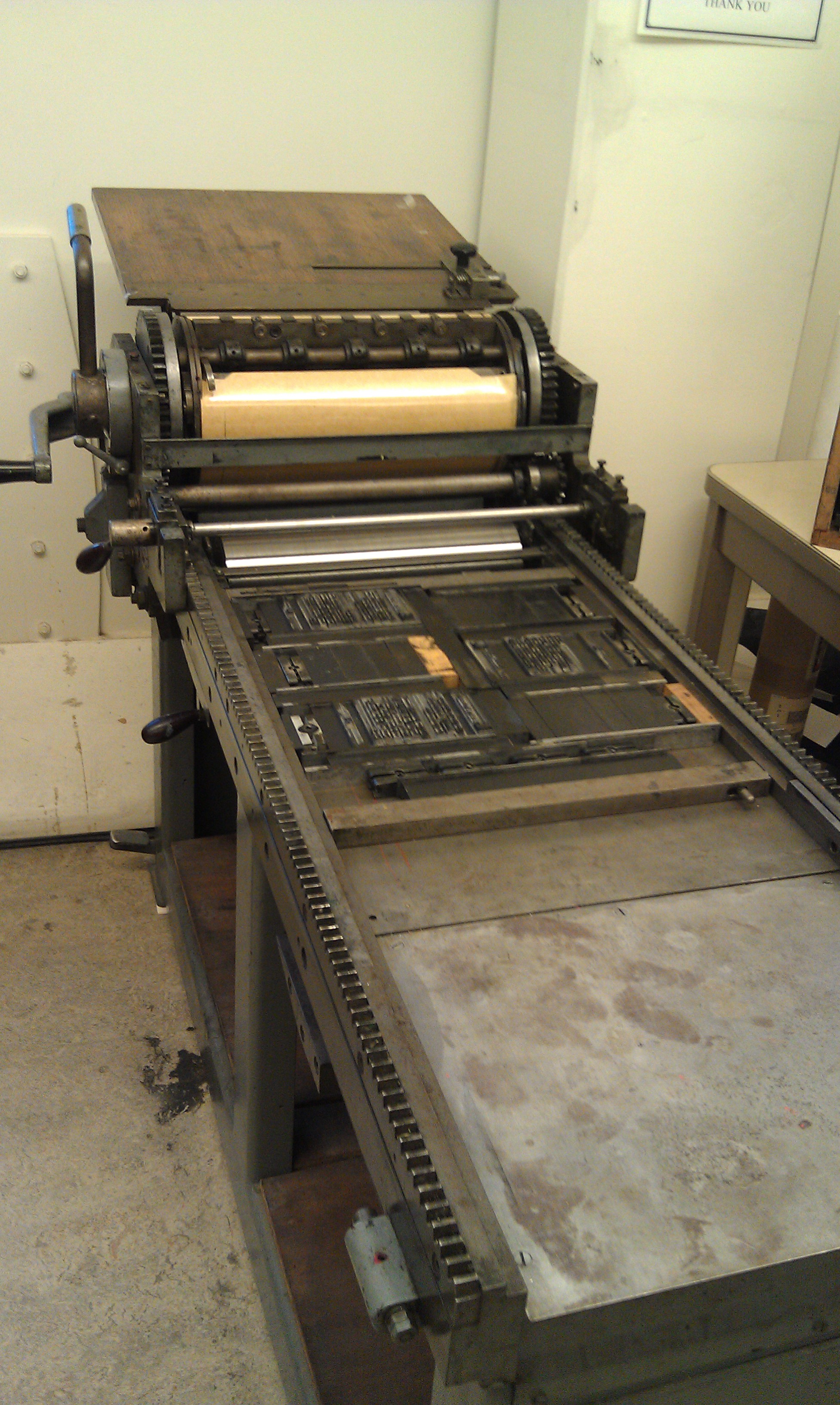
    A few of us in the Material Cultures of the Book Working Group are taking a printing class for the DE BAM. It’s really amazing to be able to learn how books are constructed first hand, but it is also a very time and labor intensive process. This photo is from my first print run on a 32 leaf octavo pamphlet. It took me 2 days of trial and error (along with a mid-print-run set-back), but it turned out well in the end.

    printing-press

  • Japanese Prints: Hokusai, Exhibit Review

    Perhaps I was spoiled in my youth, growing up near the Seattle Asian Art Museum, or maybe it was my long-standing fascination with Hokusai’s work, but LACMA’s Japanese Prints: Hokusai exhibit was underwhelming.  This did not stem from the number of pieces—seeing even a single Hokusai print is impressive, let alone the Waterfall series which is rare—or its location in a cramped, narrow hallway in the Pavilion for Japanese Art. Instead my disappointment came from the exhibit’s lack of structural unity, historical context, and understanding of print.

    Hokusai was most likely born in October, 1760 and died in May, 1849. During his life he revolutionized—both methodologically and aesthetically—Japanese woodblock print. Starting his career as an apprentice to Shunsho, he crafted images traditional to Japanese art, including courtesans, actors, and philosophers. Several of these early prints are included in this exhibit, the Two Kyoka poets: Kinkosha Karomichi and Fukujuso being a particularly elegant example. Even in this more traditional image, Hokusai’s hand is clearly seen: the artful symmetry, the wave-like flowing clothing, and the subtle shading.

    After the death of his master, Hokusai began to explore his interest in the everyday life of his fellow urban Japanese. Images of wrestlers preparing for a fight or bathers mid-bath, captured movement and energy in ways never before seen in woodblock. I was pleased to see that pieces from both of these earlier stages of Hokusai’s work were included in this exhibit. In fact, I had never seen examples quite as interesting—in content, in style, and in artistry. However, the internal organization of the exhibit is quite confusing.  The Two Kyoka poets is mixed in with pieces from his work on everyday life, which in turn appear next to examples of the work of his students. All of this without an explanatory note about either the time frame or the perceived unity of these works.

    The rest of the exhibit focused on the later stage of Hokusai’s career: his landscapes. Although most people associate Japanese woodblock prints with sweeping landscapes, populated by people or animals, this was actually Hokusai’s invention. Fascinated (obsessed?) with Mount Fuji, he created a series of images depicting the mountain in its various moods, several of which are included in this exhibit. Also included is a print of his most famous work, Great Wave off Kanagawa—an obvious draw for people less familiar with his work. Again, there is a bit of information about these prints included in a placard; however, these images are mostly left to float alone on the walls, not rooted anywhere or at any time.

    The crowning achievement, the real reason I wanted to see this exhibit was the inclusion of Hokusai’s A Tour of Waterfalls in the Provinces. Though not as iconic as his great waves, these waterfalls represent one of his greatest achievements. For Hokusai, water, like the rest of nature, had structure—where our eyes see change, he saw stability. In this series he works through this idea by depicting various Japanese waterfalls at different times of day and year. Each clearly has its own character, its own structure. Including this series lends weight to the exhibit overall, and will draw aficionados of Hokusai’s work.

    His technical prowess, to manipulate the woodblock medium in order to produce layers of perfect shading, combined with his interest in the everyday lives of fellow urban Japanese and in the structure of water revolutionized not only Japanese art, but also art in the west. However, this revolutionary aspect is missing from the narrative (or lack thereof) this exhibit provides.

    That being said, the online component of this exhibit is outstanding. From the high resolution versions of the prints to its accompanying text, it does a lot to contextualize Hokusai as well as the individual images within a larger woodblock and Japanese artistic history. Yet, I came across this digital component by accident—I wanted to know what one of the prints was called. This makes me wonder whether or not these two elements were meant to be seen together. Perhaps the physical exhibit would not have seemed so disjointed if I had been made aware of the digital component.

    When I was in high school, I bought a Hokusai calendar—the pictures were pretty and the colors went well with my room. I had no idea who he was or that he was famous; it was not until several years later that I learned his prints were nothing like the glossy images on my wall. The Japanese Prints: Hokusai exhibit reminds me of this calendar: a series of pretty prints, which were put together simply because they share the same artist and divorced from their historical and aesthetic context. Nevertheless, when combined with the information on the LACMA website, this exhibit is worth a stopover on your way to some of the museum’s other, excellent exhibits.

    Japanese Prints: Hokusai runs through July 28th, 2013.
  • (dis)junctions 2013 – An Intimate Chat About Archives

    On the morning of Saturday April 6th, a number of our members gathered for a special session at the 2013 (dis)junctions Graduate Student Conference, an interdisciplinary conference hosted annually here at UCR and put on entirely by the graduate students from the English department. Initially titled the “BAM and Book History Working Group Special Panel” we re-titled it in the introductory discussion as “An Intimate Chat about Archives” – owing both to the fact that, as a first panel of the day, the audience was sparsely populated, and that the short five-minute talks given by the panelists all revisited material produced for a seminar on archival theory taught by English Professor Robb Hernandez the previous quarter. It was a productive chat, however, and felt like a nice development of our fledgling working group meetings.

    I’ve included below the opening remarks for the panel, which were intended to put our work in conversation with the theme of the conference, which was ‘encounters’:

    Our goal for this “lightening round” is to explore several perspectives on book history and the places and spaces of books in the archive. We will encounter material forms of knowledge with and within texts. Our papers will touch on a variety of time periods, topics and materials.

    We would like to consider the place of encounter as a theoretical concept in book history studies. Encounters happen between readers and texts, of course, often in an immediately material sense – the book may be accidentally encountered, serendipitously. The text, however, in the traditional codex book, must be encountered deliberately. Similarly, encounters in the archive might be between researchers and documents, scholars and librarians, or between the space and the resurrected dead of the archival material.

    For this purpose, while we will each be presenting work that is a part of a larger project, I would like to ask both our audience and my fellow panelists today to focus not only on individual arguments but on the variety of book historical methodologies, theories and sources being employed, as our goal is to have an expansive conversation about new directions for book, archive and manuscript studies.

    Anne Sullivan presented a paper positioning Wilkie Collins’ Victorian mystery novel The Woman in White as operating like an archive, containing the documents of individual testimonies that must be examined for evidence. Her talk also delved interestingly into the reproduction of visual document structures – or the lack thereof – in the novel’s remediation from serial to first edition codex, to its most recent reprinting by Penguin. Jessica Roberson presented on the reformation of urban graveyards in the nineteenth century, and the establishment of the modern cemetery within an archival discourse. Her talk also explored briefly the interactions of bodies and books contained within literal and figurative graves. Ann Garascia discussed the representation of ‘strong men’ within a critical theorization of freak performance, examining the strong man figure as documented in the online archives of the Circus Oz and in photography holdings of the San Francisco Public Library. Brittany Chataignier considered the archive of Hamlet, consisting of the material, the performed, and the speculative. Her paper productively wrestled with Diana Taylor’s theories of repertoire and the needs of Early Modern studies.

    All four panelists and our engaged, informative audience members explored during a lengthy Q and A questions of encounter and confrontation with archives and archival methods, and the hierarchies of archival knowledge. We all emerged, I hope, with new ideas to chew on and to bring up in later meetings, especially as we continue to return to UCR’s own Special Collections to talk and work.

  • April Meeting

    Our April Meeting will take place on Tuesday April 30th at 3:30pm (location TBA). For this meeting , Schuyler Eastin will provide a theoretical reading to guide our discussion of some medieval manuscripts. We look forward to seeing you there!