NYPL librarian and author of Bibliocraft: Using Library Resources to Jumpstart Creative Projects will be the guest of honor at this event on Monday, October 27th. See the UCLA Library calendar for more information: Bibliocraft @ UCLA
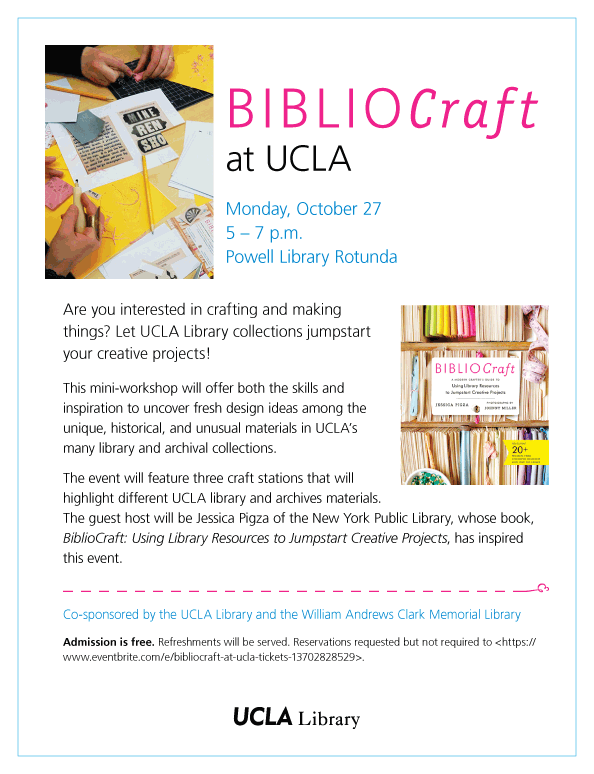
NYPL librarian and author of Bibliocraft: Using Library Resources to Jumpstart Creative Projects will be the guest of honor at this event on Monday, October 27th. See the UCLA Library calendar for more information: Bibliocraft @ UCLA
The Material Cultures of the Book Working Group at UC Riverside is pleased to present:
“Women’s Revolutionary Translation: British-German Books in the 1790s”
Alessa Johns (UC Davis)
Thursday May 8, 1:00-2:30, in HMNSS 2212
If you have any questions, please contact Rebecca Addicks-Salerno (raddi001@ucr.edu).
This event is free and open to the public!
The Material Cultures of the Book Mellon Group, along with the Department of English, are pleased to announce an upcoming talk by Carla Mazzio! This talk is open to the public.
The Trouble with Numbers: Calculation and Humanism from the “How-To” Book to Hamlet- A Talk by Carla Mazzio.
This lecture, part of Mazzio’s book in progress, Calculating Minds: The Drama of Mathematics in the Age of Shakespeare, explores the affective and dramatic dimensions of mathematical discourse in late sixteenth- and early seventeenth-century England.
Tuesday March 11, 2014 (4pm)
UCR Department of English
HMNSS 2212
Snacks will be served!
BIO
Carla Mazzio, Director of Graduate Studies in English at the University at Buffalo, SUNY, specializes in early modern literature in relationship to the history of science, the history of the body, and the history of language and the material book. She the author of The Inarticulate Renaissance: Language Trouble in an Age of Eloquence (awarded the 2010 Roland H. Bainton Book Prize) and co-author of Book Use, Book Theory: 1500-1700 (2005). She is also the editor of Shakespeare & Science (2009) and the co-editor of three books, including Historicism, Psychoanalysis and Early Modern Culture (with Douglas Trevor) and The Body in Parts: Fantasies of Corporeality in Early Modern Europe (with David Hillman, awarded the English Association Beatrice White Book Prize). Mazzio, currently the co-director (with James Bono) of the “Humanities, Science and the Arts” Research Workshop at UB, will be speaking with us about her book in progress, “Calculating Minds: The Drama of Mathematics in the Age of Shakespeare,” under advance contract with the University of Chicago Press.
The Edward Dean Museum in Cherry Valley is opening a new exhibit on print culture and books on September 14th. Rebecca will be hosting an informal gathering for Material Cultures of the Book Working Group members and guests after the exhibit opening, so let her know if you would like to attend!
~~~
Edward-Dean Museum presents a new exhibition, Secrets in the Script This exhibit examines the impact and beauty of printed words and images from the 16th to 19th centuries.
Visit to see how coffee houses became the meeting places where all could gather over a “cup of brew.” Pick up a free cup of coffee to enjoy while you view prints and rare books from the Edward-Dean Collection.
Please join us for the Year-End Colloquium for Graduate Students in “BAM.”
Designated Emphasis in Book, Archive, and Manuscript Studies – http://bam.ucr.edu
Friday, June 7, 10:00am to Noon
English Department Conference Room (HMNSS 2212)
Presentations by Steve Anderson, Cori Knight, and Heather Van Mouwerik
Display of printshop projects by Rebecca Addicks, Ann Garascia, Cori Knight, Jessica Roberson, and Anne Sullivan
This will also be a celebration of the new Mellon Workshop Grant awarded to the Material Cultures of the Book Working Group
Cindy Keefer, Archivist, Curator & Director . Center for Visual Music
Preserving Visual Music : The Archives of the Center for Visual Music
THURSDAY . May 30 . 4:30 PM . INTN 1113 . Refreshments served .
Cindy Keefer, Director of the Center for Visual Music Los Angeles, will discuss and screen work by pioneers of kinetic art, abstract animation and pre-digital cinema from CVM’s archives. CVM is a Los Angeles archive dedicated to visual music, experimental animation and abstract media. CVM preserves and promotes films by Oskar Fischinger, Jordan Belson, Charles Dockum, Mary Ellen Bute, Jules Engel, Harry Smith and others, as well as contemporary artists. Keefer will screen work from CVM’s archives by Fischinger and Belson, plus Dockum’s Mobilcolor Projections, Bute’s Abstronics (an early oscilloscope film), a short Bute documentary, and more. She will also discuss Belson’s now legendary 1950s Vortex Concerts, CVM’s work with the Fischinger legacy, current preservation work, and Raumlichtkunst, the new HD 3-screen reconstruction of Fischinger’s 1920s multiple-projector performances, recently exhibited at the Whitney Museum, the Tate Modern, and scheduled for exhibition at the Palais de Tokyo in Paris in summer 2013.
This is the last event Critical Digital Humanities will host for the 2012-2013 season. Please join us for this exciting presentation. http://cdh.ucr.edu
UCR ARTSblock presents the exhibition:
Geographies of Detention: From Guantánamo to the Golden Gulag
June 1 – September 7, 2013*
California Museum of Photography, UCR ARTSblock
UCR ARTSblock presents Geographies of Detention: From Guantánamo to the Golden Gulag, on view at the California Museum of Photography from June 1 through September 7, 2013. The exhibition is guest curated by Catherine Gudis, Molly McGarry, and graduate students from the UCR Public History Program: Leann Do, Jay Hartzell, Kristen Hayashi, Corinne Knight, Sean Milanovich, Karen Raines, Carolyn Schutten, Megan Suster, Jennifer Thornton, David Wagner, and Jennifer Weed.
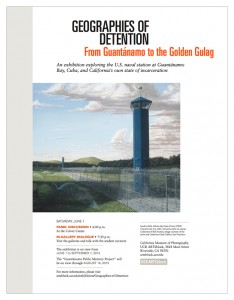 Presented on two floors of the California Museum of Photography, Geographies of Detention offers a nuanced investigation into incarceration and its architectures. One portion of the exhibition highlights work by artists Sandow Birk, Alyse Emdur, and Richard Ross, each of whom explores different aspects of imprisonment. Geographies of Detention also includes the traveling exhibit the “Guantánamo Public Memory Project,” an examination of the over 100-year history of the US naval station at Guantánamo Bay, Cuba.
The main gallery of the museum is devoted to the contemporary context and landscape of California’s own “golden gulag.” Prison populations in California have grown 500% in the last decades even as crime rates subside, and prison spending continues to outweigh state funding for public education. A selection of hauntingly evocative paintings by Sandow Birk from his series “Prisonation” (2001) reflects on the growth of California’s prison industrial complex by engaging its geographic context. Taking inspiration from pictorial genres of landscape painting, including those popularized by the Hudson River School in the 19th century, each of Birk’s paintings depicts one of California’s state prisons, from Pelican Bay in Northern California to Centinela State Prison at the US–Mexico border.
While Birk’s work shows the prisons from afar, Richard Ross and Alyse Emdur take the viewer inside these structures. In his series of photographs “Architecture of Authority” (2007), Ross explores the built environment of prisons, revealing the spatial logic used to exert power over the bodies incarcerated within. Emdur’s large-scale photographs of prison visiting rooms and collected letters and snapshots (some of which appear in her 2013 book, Prison Landscapes) offer a more intimate vision of inmates posing with their visitors against murals in fantasy landscapes of freedom. Presented together, the works of Birk, Ross, and Emdur meditate on the “carceral state” of California.
The “Guantánamo Public Memory Project” combines historical and contemporary photography, film, and first-person audio interviews to examine how the naval base has been “closed” and reopened for more than a century leading up to the attacks on September 11, 2001. These new perspectives on Guantánamo’s history as a “legal black hole” provoke discussions about the limits of democracy and the meaning of mass incarceration in a global present and future.
Collaboratively curated by eleven universities (including UCR), the “Guantánamo Public Memory Project” is comprised of a deeply researched traveling exhibit, as well as a website (www.gitmomemory.org), blog, and ongoing public conversation. The panel produced by graduate students in UCR’s Public History Program examines Guantánamo as an international symbol of America’s War on Terror and a lightning rod for debates about torture, detention, national security, and human rights.
Visit artsblock.ucr.edu for the schedule of related programs.
*The “Guantánamo Public Memory Project” will be on view as part of Geographies of Detention through August 10, 2013.
This exhibition was made possible in part by the generous support of Dean Stephen Cullenberg, UCR College of Humanities, Arts, and Social Sciences, and the UCR History Department’s Friends of Public History.
California Museum of Photography Sweeney Art Gallery
Culver Center of the Arts University of California, Riverside
3834 Main Street Riverside, CA 92501 951.827.3755
The archive, as both an organizer of knowledge and a historical place, is a problematic category–one which this inaugural and international workshop will address.
In Global Archivalities we will be discussing comparative approaches to record-keeping in pre-modern societies, including materials and methodologies used by these past ‘archives’ as well as modern-day terminologies and frameworks for understanding these phenomena.
Please come discuss these issues with us!
General Information
When? Tuesday, May 7th at 9:00 AM-11:30AM
Where? History Department Library, HMNSS 1304, UCR
To read the pre-circulated papers, if you have any questions, or if you want guest access to the Adobe Connect site, please contact Heather at hvanm001@ucr.edu.
Refreshments will be provided.
Schedule
9:00 AM–Welcome and Opening Statement: Randolph Head, UC Riverside
9:10 AM–Introduction of Presenter Sites and their Projects
9:40 AM–Terminology: a response/critique to Head’s framework: Arndt Brendecke: escaping the term ‘archive’? and Diego Navarro: Imágen: expanding the scope of archivality?
10:00 AM–Discussion
10:30 AM–Break
10:40 AM–Getting Beyond Europe: conceptual vocabularies and frameworks: Hilde de Weerdt and Konrad Hirschler
11:00 AM–Discussion
11:20 AM–Closing Remarks with Fillipo de Vivo and Jake Soll